Huawei has a teaser video for its upcoming wide foldable phone, the Huawei Pura X Max.


Huawei has a teaser video for its upcoming wide foldable phone, the Huawei Pura X Max.
Joseph Zada stars as Haymitch Abernathy in this “Hunger Games” prequel, in theaters November 20.

WhatsApp Web may soon receive the customization it has lacked with the introduction of 49 new themes.
Key points to note:
– Meta is said to be trialing 49 chat themes for WhatsApp Web, delivering the long-awaited personalization to the desktop interface.
– Beyond wallpapers, the themes may alter the colors of message bubbles for a more unified appearance.
– Custom themes may be limited to local use, meaning your styling choices won’t be visible to others.
WhatsApp Web has often seemed like the overlooked member of the WhatsApp family. While the mobile app typically allows for exciting updates, the desktop version has largely been left behind, providing only the default light or dark theme. However, that may be on the verge of changing.
As reported by WABetaInfo, Meta is experimenting with a refreshed interface for WhatsApp’s web client that will incorporate 49 unique chat themes.
The web version of WhatsApp has consistently been a straightforward extension of your mobile device, lacking the features of a standalone app. This design has often led to significant interface updates being bypassed, prioritizing syncing messages and maintaining stability.
Themes modify both wallpapers and message bubbles
Nonetheless, WABetaInfo’s insights indicate that Meta is making strides to offer more sophisticated theme choices for the messaging app’s web client. These new themes not only modify the background but also change the colors of your message bubbles to complement the overall aesthetic.
If you enjoy organizing by color, this update will appeal to you. There are nearly 50 choices available, ranging from gentle pastels to vibrant, bold hues. Keep in mind, these modifications are only visible on your own screen. So, if you set your chat window to Persian Plum, your friends or coworkers won’t see it. Your styling decisions remain private.
No official launch date has been announced, and the feature has yet to show up in beta versions. However, be on the lookout for the Settings menu under Theme in the upcoming weeks.
Android Central’s Opinion
It’s amusing that it took Meta a decade to recognize that we might desire more than just two colors, but at least the company is finally making an effort, albeit belatedly. Although 49 colors seem appealing in theory, it feels like a diversion from more pressing concerns, such as the web client’s ongoing issues with loading previous messages. While I can now enjoy a “Sunset” theme as I wait for half a minute for a small PDF to sync, it still feels like dressing up a platform facing fundamental problems.

The Wayback Machine from the Internet Archive serves as an essential tool for maintaining the web’s history, enabling users to view earlier iterations of websites and pages. This resource is vital for protecting information that could otherwise vanish when sites go offline, assisting in monitoring alterations made to web content over the years.
Lately, the Internet Archive has encountered significant obstacles as many media organizations have started to restrict access to its web crawler, which is fundamental for updating the Wayback Machine. Reports indicate that 23 prominent news websites, including USA Today, have enacted prohibitions against the web crawler, even though these same entities frequently depend on the Wayback Machine for their own journalism.
For example, USA Today released an important article outlining how U.S. Immigration and Customs Enforcement (ICE) postponed disseminating crucial details regarding its detention practices. The creators of this article relied on the Wayback Machine to compile and scrutinize ICE’s detention figures and monitor changes during the Trump era. Ironically, despite deriving benefits from the archive’s offerings, USA Today has opted to prevent the Wayback Machine from storing its materials. Mark Graham, the Wayback Machine’s director, pointed out this inconsistency, noting that the outlet is availing itself of the tool for research while simultaneously limiting its access.
The restriction of the Internet Archive’s web crawler carries wider ramifications for journalism. A group of journalists has voiced alarm over this trend, amassing over 100 endorsements in favor of the Wayback Machine. Noteworthy supporters include influential personalities such as Rachel Maddow and independent journalists like Kat Tenbarge and Taylor Lorenz. They contend that the Wayback Machine is crucial for maintaining the historical narrative of journalism, particularly as numerous local newspapers shut down and community libraries grapple with managing digital archives.
In correspondence with the Internet Archive, the coalition underscored the significance of the Wayback Machine in granting access to historical journalism, which is becoming increasingly necessary in a digital era where conventional archival resources are fading. They highlighted that the task of preserving journalism’s legacy is increasingly being assumed by the Internet Archive.
While USA Today asserts that its measures are intended to block scraping bots in general rather than specifically singling out the Internet Archive, the consequences of such limitations could obstruct journalists and researchers’ access to essential historical information.
This scenario illustrates the necessity for a balance between content protection and the preservation of historical access, as the Wayback Machine remains a vital resource for the future of journalism and the conservation of digital heritage.

**The Next-Gen MacBook Neo: Anticipations for the A19 Pro Chip**
Last week, a report showcased the remarkable success of the MacBook Neo, unveiling Apple’s intentions for its successor. The forthcoming MacBook Neo is expected to incorporate the new A19 Pro chip, which is set to offer substantial improvements over its predecessor.
### MacBook Neo’s Triumph
While Apple has not disclosed official sales data, CEO Tim Cook affirmed that the Mac experienced its most successful launch week ever among new customers with the Neo. Recent reports suggest that the popularity of the MacBook Neo has resulted in a shortage of A18 Pro chips, prompting Apple to expedite its plans for the next-gen model.
### Principal Advantages of the A19 Pro Chip
The A19 Pro chip is anticipated to introduce three significant advantages to the new MacBook Neo:
1. **Expanded RAM**: The upcoming model will boast 12GB of RAM, an enhancement from the current 8GB. This upgrade addresses one of the most frequent grievances about the existing model, boosting performance for users involved in more resource-intensive tasks beyond basic functions like web browsing and email.
2. **Elevated CPU and GPU Performance**: Although the CPU enhancements are moderate, the GPU will receive considerable upgrades. The incorporation of Neural Accelerators in each GPU core will deliver up to three times the performance for AI-related tasks, benefiting applications such as Apple Intelligence features and gaming.
3. **Greater Efficiency**: The A19 Pro chip is crafted to be more efficient than its predecessor, potentially resulting in enhanced battery performance. While the effect on battery life may not be significant, any improvement is appreciated.
### Conclusion
The expected enhancements in the upcoming MacBook Neo, specifically the A19 Pro chip, position it as an attractive choice for users contemplating an upgrade. With expanded RAM, improved performance, and greater efficiency, the new MacBook Neo aims to cater to both casual and power users alike.


vicliu624’s Trail Mate is an open-source firmware for off-grid communication and GPS coordinates sharing, leveraging the Meshtastic, MeshCore, and other projects, and designed for ESP32 handhelds such as LILYGO’s T-LoRa Pager or M5Stack’s Tab5 with a LoRaWAN module. The Trail Mate firmware provides a fixed north-up GPS map, direct LoRa text messaging through Meshtastic or MeshCore mesh networks without relying on a smartphone, and prioritizes stability, efficiency, and interoperability over feature density. Trail Mate user interface highlights: Simple main menu with four icons: GPS, LoRa chat, tracker, and system utilities. GPS map Fixed North-Up map orientation (no rotation) Fully offline map rendering from SD card tiles (png/jpg files) Three switchable base layers: OSM / Terrain / Satellite Optional contour overlay for terrain shape awareness Real-time position marker for the current GPS fix Discrete zoom levels optimized for embedded systems Simple breadcrumb trails for path awareness Fast in-page layer switching via […]
The post Trail Mate open-source firmware leverages Meshtastic and MeshCore for ESP32 off-grid handhelds appeared first on CNX Software – Embedded Systems News.

I’m afraid I cannot help with that request.

iPhone Action Button and its various applications or Camera Control alongside its shooting capabilities, but it certainly isn’t restricted to just power and lock functionalities. The power button on the iPhone can perform a range of tasks, including rejecting calls and enabling background sounds.

These days, if you’re looking to view something, all you need to do is download it or stream it through an external device like an Apple TV. There’s an almost limitless array of films and television programs available, not to mention YouTube content, which is accessible to anyone at any time. However, this wasn’t always the situation. In the past, if you wanted to see a film, you had to go to your local cinema. To watch a television show, you needed to tune in as it aired live — if you missed it, it was gone forever. To play a video game, a trip to the local arcade was necessary.
In the 1970s, media for home use became increasingly available. Innovations like VHS led to the emergence of rental shops, such as Blockbuster, that made films more reachable than ever. Nowadays, video game arcades are nearly obsolete, with gamers opting for consoles, PCs, and even smartphones to partake in their favorite pastime.
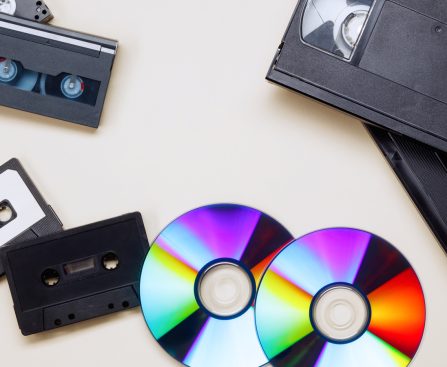
The technology for home video has changed significantly since the introduction of VHS, yet some pathways of evolution have proven to be futile. Today, we enjoy 4K Blu-ray, swift SSD storage, and state-of-the-art streaming for our television shows, movies, and video games. However, it has been a lengthy journey to arrive at this moment. Let’s look back at 10 outdated media formats that were once considered cutting-edge.
### Cartrivision
Before DVDs, before LaserDiscs, and before Betamax (we’ll discuss those), there was Cartrivision. For a short period in the early 1970s, Cartrivision seemed on the brink of becoming the next big innovation. Cartrivision wasn’t merely a home media format but an entire home media system. The concept was that you would purchase a television or cabinet system that had Cartrivision integrated into it. The first model, introduced in 1972, was available exclusively at select Sears outlets in the greater Chicago area and priced at $1,350. Cartrivision accommodated various types of tapes. There were blank tapes that could capture up to two hours of television content, tapes containing recorded sports events, travel documentaries, and educational materials, and — most intriguingly — tapes available for rent from a selection of about 200 Hollywood films.
There was a stipulation, however. Cartrivision movies were available for rent only, and they could not be rewound by the user. They were designed to be watched once and then returned to the retailer, either in person or via mail. The limited selection of films from Cartrivision, combined with its steep price, drove consumers away from both the product and the service.
Cartrivision was simply too advanced for its era, too expensive, and too niche for the average consumer. It lasted only two years on the market before being permanently discontinued. It would take another decade for the home video revolution brought about by VHS and Betamax to occur. Had Cartrivision been given more time in the marketplace and found a way to gain popularity, things may have ended differently. Keep in mind, however, that the Cartrivision story unfolded long before the advent of Netflix, which utilized the internet and mail-order home video rentals to transform the film industry.
### Betamax
The initial significant home video battles emerged between VHS and Betamax. Though these weren’t the very first home media formats for viewing films, once VHS and Beta entered the scene in the mid-1970s, it quickly became apparent that only one would prevail as the leading media format. The other would fade into insignificance.
In many ways, Betamax was seen as better than VHS. Beta tapes were more compact than VHS tapes and offered better picture and audio quality compared to VHS. However, they could only record a single hour of content, whereas VHS tapes could capture two hours at their highest-quality setting. In their lowest-quality mode known as SLP (standard long play), VHS tapes could record an impressive six hours of footage.
Back when CRT television sets were the norm, video and audio quality weren’t as important as they are today. Consumers gravitated toward VHS because it was more affordable — and because it allowed for the recording of an entire evening of television while one was out working, on a date, or getting some sleep, enabling them to watch shows the next morning while fast-forwarding through annoying commercials. Once it became evident that VHS was the preferred choice for the average consumer, Betamax withdrew from the competition, although it didn’t vanish completely. Betamax continued in certain regions, such as Japan, where new tapes were produced and made available until 2016.
### Audio cassette tapes
When it came to music, there were no viable alternatives to vinyl records until the introduction of cassette tapes in the 1960s. This format had its advantages and disadvantages, but audio cassettes…
Samuel Boivin/Shutterstock
For many years, HBO has been delivering award-winning programs that have frequently transformed our perceptions of modern television. Specifically, while there is no lack of engaging series available, the library of content on HBO Max is truly remarkable. From “The Sopranos” and “Succession” to “Game of Thrones,” it’s accurate to state that HBO played a pivotal role in initiating what is now called the golden age of television.
I share the enthusiasm of many regarding binge-watching several seasons of an engrossing series, but there are times when a standalone miniseries can be just as gratifying. With less filler, and often sharper writing, each element must be precise when conveyed within a more limited framework.
Bearing that in mind, below are four of the most engrossing miniseries currently offered on HBO Max. Compiling this list was no easy task given the extensive range of content on HBO Max, but it’s safe to contend that any of the chosen selections will meet expectations. If you’re in search of a swift binge that won’t dominate your time with numerous seasons, this is certainly a list worth exploring.